



Updated: February 2026
If you sell equipment or vehicles, Section 179 is one of the most powerful closing tools you have — and most sales teams barely use it. This page shows you how to pair equipment financing with Section 179 in real sales conversations, without turning your reps into tax advisors.
Sales-ready one-liner you can use today: “If you place this equipment or vehicle in service by year-end, you may be able to expense a large portion of the cost this year — even if you finance it. Your tax professional can confirm the details.”
Quick takeaways for sellers:
Lead with the monthly payment and business outcome; use Section 179 to explain why acting this year makes financial sense.
The key timing trigger is placed in service — delivered, installed, and ready for use — by the end of the customer’s tax year (December 31 for most calendar-year businesses).
Financing doesn’t disqualify Section 179 in most structures. That’s the single most important thing to tell cash-strapped buyers.
Add a clearly labeled “estimated after-tax cost” line to every quote so buyers can share it with their CPA.
Vehicles have special rules — share the vehicle deduction guide early to build trust.
Stay compliant: use “may,” “potential,” and “confirm with your CPA.” Never promise specific tax outcomes.
For the official 2026 limits and rules, see our Section 179 Deduction page. For financing language, see Section 179 Qualified Financing.
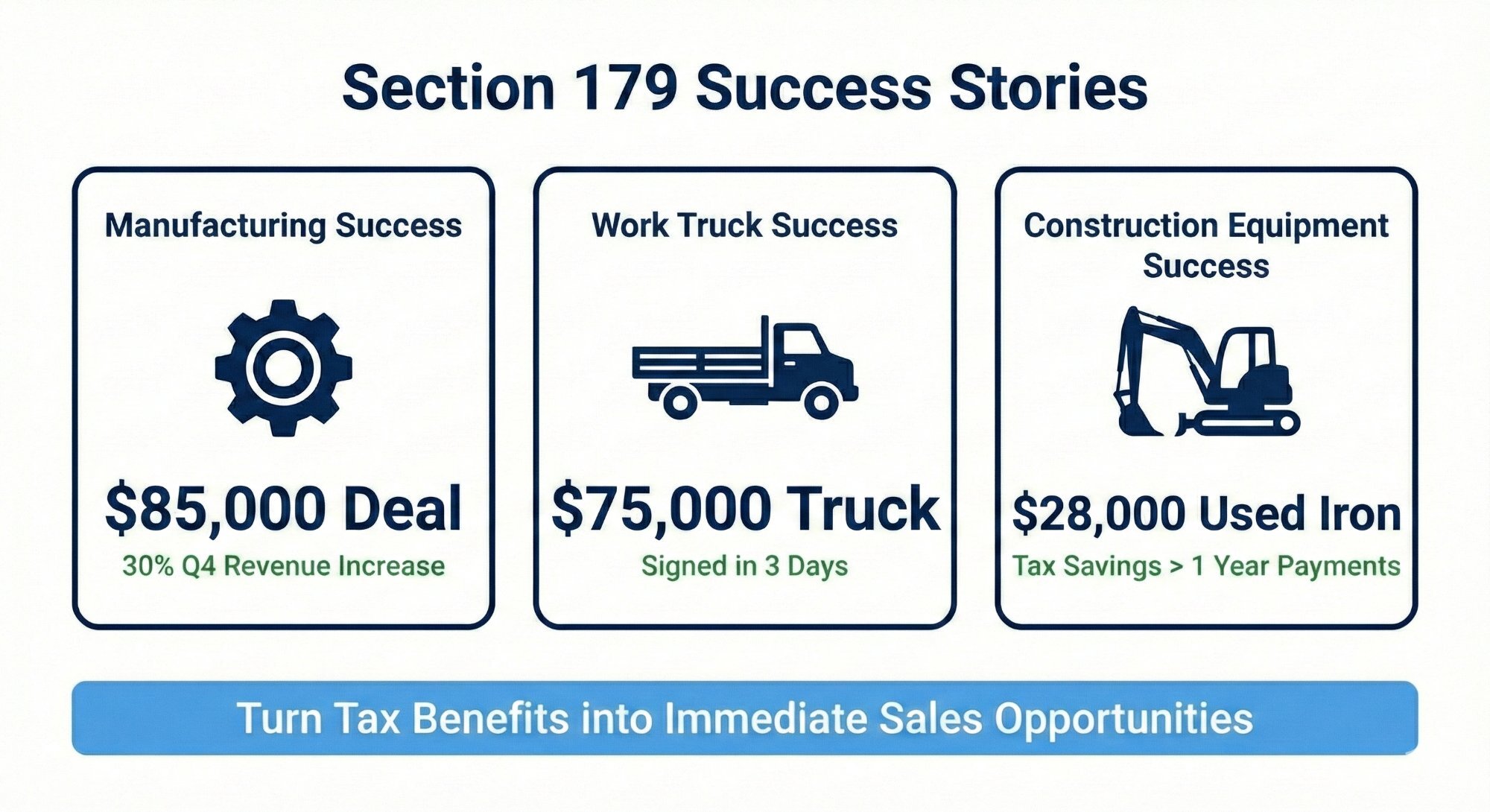
Case Studies: Financing + Section 179 Sales Plays (2026)
Case Study 1: Pulling a Stalled $85,000 Equipment Deal Into Q4 With Financing + a Placed-in-Service Plan
Note: The scenarios on this page are composite examples based on common dealer conversations. Dollar figures and performance outcomes are illustrative; actual eligibility and results depend on each customer’s tax situation and business facts.
Summary (illustrative):
- Deal size: ~$85,000 (CNC package)
- Objection: “We’ll revisit in January.”
- What changed: rep paired a monthly payment option with a delivery/install plan and an “estimated after-tax cost” line
- Outcome: deal closed in December; 30% Q4 revenue increase across the sales team
The situation: A regional CNC and fabrication distributor had the same problem every Q4 — prospects said “we’ll look at it next year.” Pipeline stalled, reps got discouraged, and December closed soft.
What the sales team did differently: Starting in October, every rep added two things to proposals: (1) a financing option with a monthly payment alongside the cash price, and (2) a simple “estimated after-tax cost” line. On an $85,000 CNC lathe, a customer in the 24% bracket could see roughly $20,400 in potential federal tax savings — making the estimated first-year cost around $64,600 before any state benefit.
Critically, the reps also built a delivery/installation schedule into each proposal so “placed in service by year-end” was a realistic plan — not wishful thinking. They didn’t try to be tax experts. They pointed customers to Section179.org and their own accountants for confirmation.
What happened: Three prospects who had been sitting on quotes since summer signed in November. Two more closed in the first two weeks of December. Q4 revenue jumped 30% compared to the prior year.
Talk track (copy/paste): “We can look at a monthly payment option so you’re not draining cash. If the machine is delivered and in use by year-end, your tax pro may be able to expense a large portion this year under Section 179 — even with financing. Want me to send a payment quote and a placed-in-service checklist you can forward to your CPA?”
Seller takeaway: Most year-end deals aren’t lost on price — they’re lost on uncertainty. Financing removes the cash-flow objection, and a placed-in-service plan removes the “we might not be ready” risk. You don’t need to sell tax law — sell clarity: payment, timing, and a realistic delivery plan.
Case Study 2: Closing a $75,000 Landscape Truck Sale the Buyer Almost Walked Away From
Summary (illustrative):
- Deal type: Landscaping work truck ($75,000, work-body upfit included)
- Objection: “I’ll think about it.”
- What changed: rep led with financing + built a delivery/upfit plan so the truck was placed in service by year-end + sent a CPA packet with VIN/specs and expected placed-in-service date
- Outcome: signed in 3 days; buyer said the CPA packet made it easy to approve quickly
The situation: A landscaping company owner was shopping for a $75,000 work truck (dump/service body setup) but left the lot saying “I’ll think about it.” The sales rep knew the prospect needed the truck — the old one was costing more in repairs than payments would be on the new one.
What the sales rep did differently: On the follow-up call, instead of offering a discount, the rep did two things: (1) sent a monthly payment option to solve the cash-flow objection, and (2) built a simple “placed in service by year-end” plan that included delivery and upfit timeline (dump body, racks, tool storage) so the truck would be ready for work before the customer’s year-end.
The rep stayed CPA-safe: “If the truck is placed in service this year and used primarily for business, your tax pro may be able to expense a large portion under Section 179 — even if you finance. Vehicle rules vary, so have your CPA confirm what applies.” She also copied the customer’s accountant and sent a clean CPA packet: VIN/spec sheet, purchase price, delivery/upfit timeline, and expected placed-in-service date.
What happened: The accountant confirmed the buyer’s timing and documentation requirements. The buyer came back three days later and signed.
Talk track (copy/paste): “Let’s look at a monthly payment option so you keep cash in the business. If we can get the truck delivered, upfitted, and ready for work by year-end, your tax pro may be able to expense a large portion this year under Section 179 — even with financing. Want me to send a payment quote and a one-page CPA packet with the VIN/specs and expected placed-in-service date?”
Seller takeaway: Commercial vehicles close faster when you sell clarity: payment + timing + a clean CPA packet. Don’t guess at vehicle limits on the fly — send the specs and link the buyer to the vehicle guide, then let the CPA confirm. For the full vehicle rules, see our Section 179 Vehicle Deductions page.
Case Study 3: Using Financing to Turn “Can’t Afford It” Into “Can’t Afford Not To”
Summary (illustrative):
- Deal size: $28,000 (used yellow iron — compact excavator + delivery + setup)
- Objection: “Capital budget is tapped out.”
- What changed: rep bundled the full package into one financed monthly payment and showed the after-tax math
- Outcome: approved the same week — not because the price dropped, but because the net cost made sense
The situation: A small construction contractor needed a used compact excavator to keep up with jobs, but the owner said the $28,000 price tag was more than he could swing — capital budget was tapped out for the year.
What the sales rep did differently: Instead of cutting the price, the rep introduced equipment financing and quoted the used machine (excavator + bucket + delivery + prep) as a single monthly payment of roughly $540. Then he added the after-tax math: at a 24% federal rate, the Section 179 deduction on $28,000 could save roughly $6,720 in federal taxes — enough to cover more than 12 months of payments in the first year alone.
He labeled the estimate clearly (“for discussion with your CPA — actual savings depend on your tax situation”) and included a simple documentation list: bill of sale/invoice, serial number, placed-in-service date, business-use confirmation, and financing agreement.
What happened: The owner forwarded the proposal to his CPA. They approved it the same week — not because the price dropped, but because the net cost made sense once potential tax savings were factored in.
Talk track (copy/paste): “Let’s quote the used machine as one monthly payment so you know your real cash-flow number. If your CPA says you qualify, placing the equipment in service this year may reduce the after-tax cost significantly. Want me to put together the payment quote and a one-page estimate you can forward?”
Seller takeaway: “We don’t have the budget” often means “we don’t have the cash right now.” Financing solves the cash problem. Section 179 may reduce the after-tax cost — and used equipment can qualify when it’s new to the buyer, so don’t treat used iron like a second-class sale. Together, they address the two most common objections. For financing details, see our Equipment Financing Options page.
Seller FAQ: What You Can Safely Say in 2026 (Without Giving Tax Advice)
Q: What’s a clean one-liner I can use in a sales conversation?
A: “Section 179 is a tax rule that may let your business expense qualifying equipment or vehicles in the year they’re placed in service — so the after-tax cost can be lower than the sticker price, even if you finance.” Then encourage the customer to confirm eligibility with their tax professional.
Q: What does “placed in service” mean, and how do I use it to create urgency?
A: It generally means the equipment or vehicle is delivered, installed (if applicable), and ready and available for business use. For most calendar-year businesses, that means by December 31 — but some businesses use a different tax year, so confirm with the buyer. Build a delivery/install schedule into your proposal so the deadline is a plan, not a surprise.
Q: Can customers claim Section 179 if they finance?
A: Yes. If the customer is treated as the owner for tax purposes (common with equipment loans and many $1 buyout structures), the deduction is generally based on the full purchase price — not the amount paid up front. The asset still needs to be placed in service by the end of the buyer’s tax year. Operating leases may differ. Link customers to the financing basics page and advise them to confirm with their tax pro.
Q: Does equipment have to be new?
A: No. New or used equipment can qualify as long as it’s “new to the buyer” and used more than 50% for business. Link customers to the qualifying property page for details.
Q: What about vehicles — can I promote Section 179 on work trucks and commercial vehicles?
A: Vehicle deductions can be more nuanced than equipment (vehicle classification, business-use substantiation, and annual caps for some vehicle types). Don’t guess at specific limits on the fly — use the vehicle deductions guide as your reference and encourage the customer to confirm details with their CPA.
Q: What are the key Section 179 numbers for 2026 I can mention?
A: For tax years beginning in 2026: maximum Section 179 deduction is $2,560,000; phase-out begins at $4,090,000 of qualifying property placed in service and is fully phased out at $6,650,000; Section 179 is also limited by the buyer’s taxable business income. Bonus depreciation is 100% for eligible property acquired after January 19, 2025 (generally claimed in the year placed in service). Always link to the full limits page and encourage CPA confirmation.
Q: What if my customer hits a Section 179 limit (income or phase-out)?
A: The deduction is limited by taxable income (unused amounts may carry forward), and bonus depreciation may provide additional first-year write-offs for eligible property. Encourage the buyer to ask their CPA about both options. For a comparison, see our Section 179 vs. Bonus Depreciation page.
Q: What should I give the customer’s CPA to make their job easy?
A: A clean “CPA packet” with: final invoice showing purchase price and date; delivery/acceptance paperwork with the placed-in-service date; VIN or serial number; financing documents (if applicable); and any upfit or installation invoices tied to the asset. Avoid promising deductions — send the CPA our reference pages instead. For filing details, see How to Elect Section 179 (Form 4562).
Q: Do states follow Section 179 the same way?
A: Not always. State conformity can differ, which may change the customer’s total tax impact. See our Section 179 by State page for a state-by-state overview.
Q: How can I promote Section 179 + financing effectively without making promises?
A: A few high-impact moves: add “Section 179 may apply” language to product pages and quotes (with a link to the official limits page); include a monthly payment option on every proposal; add a calculator-based estimate labeled “for discussion with your CPA”; and use Section 179 Qualified badges on your website and sales materials. For free badges and website code, see our Equipment & Vehicle Seller Info page.
Turn These Sales Plays Into Closed Deals
Every scenario above follows the same workflow. Use it on every deal:
- Quote the cash price and at least one monthly payment option.
- Add a clearly labeled “estimated after-tax cost” line to the proposal.
- Build a placed-in-service plan (delivery, install, training) that’s realistic before the buyer’s year-end.
- Send a short follow-up the buyer can forward to their CPA — include the payment quote, the estimate, and links to Section179.org.
You don’t need to be a tax expert. You need a financing option, a delivery plan, and one sentence: “Your CPA can confirm whether Section 179 applies — but if it does, acting this year may reduce your after-tax cost.”
Explore Sales & Marketing Strategies for Sellers →
See Equipment Sales Financing Options →
Review Section 179 Qualified Financing →
Try the Section 179 Calculator →
Disclaimer: This content is general information only and is not tax, legal, or financial advice. The scenarios on this page are illustrative and anonymized; actual eligibility and tax results depend on the customer’s facts, tax situation, and current law. Section179.Org, its affiliates, and contributors expressly disclaim any liability for errors, omissions, or reliance on this information. Encourage customers to consult a qualified tax professional before making decisions or claiming deductions.
Sources: Rev. Proc. 2025-32 (2026 Section 179 inflation adjustments); IRS Notice 2026-11 (bonus depreciation guidance); Instructions for Form 4562.